My Goals as a Trans Writer
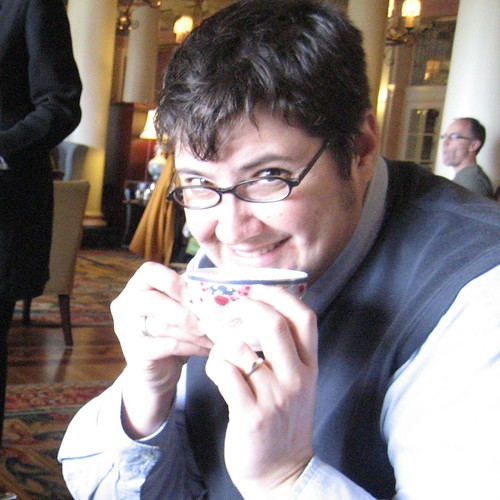 Like many writers I know, I took a meandering path to this writing profession, starting out confident and then dedicating a long decade in quicksand—I think it’s called self-doubt—after which I think I found myself in the center of the earth, and let me just say, it’s hotter than I thought it would be down there. During this long break I suppose I opted to have a sex change, and then I realized that I needed to write about my transition. I didn’t want to relate a tale of anguish and grief. Instead, I focused on the ludicrous situations that popped up as I navigated through gender roles, gathered information on doctors, civil courts, and resources, and klutzed into whatever manhood I now find myself. Where I have ended up as a writer is not where I estimated I’d find myself, but I understand now that all of my wanderlust has made me a much better storyteller. And along the way, I’ve identified my audience in young adult readers, in whatever stripe of gender and sexual orientation (or questioning place) they may be. I now have a good idea of my goals as a writer of transgender and queer experience.
1. Write believable characters who aren’t all about being LGBT—Nobody is simply the sum of the aspects of their identities. When I write out character sketches for my characters, I make sure not to prioritize their queerness; I may begin by thinking about how much they hate their trumpet practice time, or what vegetables they despise, or whether they wake up before their alarm clock sounds, anything to make them more layered as people. That doesn’t mean the LGBT isn’t significant. To the contrary, I’ll spend time working through those issues, writing up back story about how they identify, when they first thought about being L, G, B, and/or T, and what emotions they feel about being different. Are they defensive about it? Do they use humor to deflect attention from it? Who have they told about their feelings? Because I want my readers to be able to identify with the protagonist and other characters, I try to get as good a fix as I can on the whole perso, with specific attention paid to where and how they fit into the LGBT world.
2. Write against type in character and situation—In my humble opinion, there are enough narratives out there about how awful life as a queer teenager or young adult can be. I’m not espousing a rose-colored lens on the world here, but I don’t feel the need to recreate The Well of Loneliness, either, with all due respect to Radclyffe Hall. I’m interested in young trans women characters who are smart and sassy, young trans men who don’t reinforce macho stereotypes, gender bending characters who won’t be pinned down, and gender nonconforming kids who help illustrate where the boundaries are between expressing one’s gay or lesbian orientation, and one’s gender identity. I don’t need to write the transsexual as serial killer or Ms. Lonelyhearts, especially not for a YA audience.
3. Envision novel universes that help push an exploration of LGBT issues—My latest novel, which is nearing its last revision before I peddle it at summer conferences features a time-traveling epileptic teenager who shifts genders as he slips into Prohibition-era Kentucky. Jumping into the body of a girl is the last thing he thinks he needs, but by the end of the book, he makes some interesting choices after growing as a character. I was interested in making orientation and gender so fluid in the narrative that it would even be difficult to assign a pronoun to the protagonist. And I hope that the action-adventure tale brings a playfulness to the more grounded LGBT questions and keeps the reader absorbed while they have a chance to rethink issues of queerness.
4. Give LGBT readers someone to identify with—I remember contorting myself around mainstream YA novels when I was an adolescent, and although I didn’t realize it at the time, I was often left alienated or disappointed. It was hard not to see big parts of myself in books by Paula Danziger, Judy Blume, and others, especially when friends gushed about how great they were. I turned to science fiction and fantasy, which at least created worlds in which I could lose myself. What if YA books hit all bases? Great story, great characters, great lessons, and inclusive of LGBT and questioning youth? I want to provide all of that.
I’m excited for the opportunity to explore some of these questions here at GayYA over the next several weeks, and I hope to see dialogue in the comment threads. I post over at my own blog, Trans/Plant/Portation, write popular culture commentary at I Fry Mine in Butter, and in June and July, will return to Bitch Magazine’s blog to look at the early campaigning for President. Because as part of my indirect writer’s path, I focus on all kinds of things. Thanks for letting me spend some time here, and howdy.
Everett
A Message to Writers
To some people, I guess it’d be a mystery as to why I would choose to come out as a bisexual for the first time here and now. (God, writing this is so scary. Bear with me!) It took me a couple of days to figure it out myself. Sure, I’ve told my husband, and my best friend, and my mother during one especially passionate screaming match. But I never really felt the need to bring it to attention before, so I just treated it like some intensely private thing.
I’m a happily married, twenty-three year old woman with a sixteen month old. To a lot of people, that would automatically mean that I am straight, or that my bisexuality is somehow canceled out simply because I have found the person I want to spend the rest of my life with, and he’s a man. People have such weird ideas about bisexuality.
That’s why I’m here, I guess. Because of how bisexuals are so often portrayed, especially young bisexual females.
I live in a small town, and at my high school there were only a few openly gay people. But one time these two girls who were both known to have had boyfriends in the past started holding hands in the hallway, and kissing each other around campus. They changed their statuses online and let it be known that they were officially dating.
The most common reaction amongst my classmates? “They’re doing it for attention.” “They’re doing it so guys will think they’re hot.” “They’re doing it to be trendy.
Nobody took them seriously. And if it’s not sad enough seeing these reactions in person, imagine reading books and watching TV and movies were the majority of young bisexual females are portrayed as overly promiscuous bad girls who are more into the sex than anything else. (And hey, of course that person exists, and that’s totally okay. It’s not, however, an accurate or fair representation of all young female bisexuals.)
I saw this episode of Tyra that was all about “Barsexuals.” Apparently a barsexual is a straight female who makes out with other women in bars in order to score men and get free drinks. When asked if they are bisexual, these women were quick to deny. Whether they were lying, or weren’t sure, or were telling the straight up truth, why are situations like these being highlighted as opposed to more authentic ones?
I know it happens. But there just isn’t enough of the average. I was inspired by Scott Tracey’s post about having gay characters that are simply gay. Their sexual orientation is just another part of them, rather than being a highlighted feature in the story. I haven’t read many books featuring bisexual characters, but the few that I have read were portrayed dryly and with hurried cliches. And while bisexual characters in general would be a refreshing thing to see, it’d be even more impressive to meet a serious but totally average teen bisexual. (If anyone has any suggestions, I’d love for you to leave them in the comments so I could read up!)
It’d be extra difficult to cover I know, since high school can be a confusing time as far as sexuality goes. While I was in high school, I definitely would have put myself in the Q category of LGBTQ, rather than the B. But I know that there are young female bisexuals out there, wondering why they aren’t anything like the bisexuals they see in books and on TV.
And it’s for those girls that I’m here now. Write your characters, tell your story, be yourself. But please, on behalf of the evolution of human acceptance, ask yourself if it’s possible to include LGBTQ characters in your novel. Bisexuality, being gay, being transsexual, these aren’t new things. The number of LGBTQ people isn’t rising, it’s just that the number of people comfortable enough to admit it is. If we can support each other enough through our writing to keep that number rising, having a more true to reality ratio in the media will follow naturally.
Amy Lukavics is a YA writer represented by Joanna Volpe of Nancy Coffey Literary and Media Representation. Besides writing and reading, her other favorite activities include tearing it up on Xbox Live, cooking things that call for at least 4 cloves of garlic, and building pillow forts with her daughter Lily Mila. Gamertag: electric lola Twitter: @amylukavics Blog: hello, moon.
This post is a part of our reader submissions program. To find out how you can contribute to posts on the Gay YA, click here.
Author Wednesday: Ellen Wittlinger
 Ellen Wittlinger is the author of Hard Love, Parrotfish, and many other novels for young adults. She can be found online at her website.
In 1997 when I began writing the novel Hard Love, most (if not all) of the YA novels with GLBT characters dealt with the process and difficulties of coming out. But when I looked around it seemed to me that there were a lot of teens for whom coming out was no longer such a big deal—they were past that stage already. I thought it was important to look at the question, “What comes next?” I decided to try writing a character who was moving on, a girl who was out and easy with it, but who had other problems, the same problems most teens have: how to get along with her parents, how to make sense of her heritage and her gifts, how to find love.
And so Marisol Guzman was born: a “Puerto Rican Cuban Yankee Cambridge, Massachusetts, rich spoiled lesbian private-school gifted-and-talented writer virgin looking for love.” In other words, Marisol was a lesbian, but that was not by any means her entire identity. She defined herself in a variety of interesting ways.
It’s probably time now to admit that I am not G,L,B, T or even Q. I’m also not young. I grew up in the Sixties when an admission of homosexuality made you (at least) the black sheep of your family, and very likely caused a more permanent rift with them. Maybe because I had problems with my own family, I felt a strong bond with the gay and lesbian people I met which was solidified by living for three years in Provincetown, Massachusetts, a small, quirky fishing village on Cape Cod that has for decades been a mecca for artists, writers and GLBT people. It was and is a unique place where the locals make room for and celebrate each other’s differences and eccentricities. And it had a profound effect on the way I chose to live my life.
I knew I wanted to include gay and lesbian characters in my YA novels from early on—that was part of the world I lived in. I was not worried that I hadn’t “walked in their shoes.” There are only so many shoes a person can walk in, and if a writer limits herself to only writing about direct personal experience, her stories will be very repetitive. Besides, the way I’d always built my characters was from the inside out—the inside being that small core place in which we are all the same, the outside being all those millions of ways in which we’re all different. To my mind, this is the best way to guard against stereotypes.
Hard Love did well, winning both a Lambda Literary Award and a Michael L. Printz Honor Award from the American Library Association, and some years later I wrote a companion novel called Love & Lies: Marisol’s Story which followed Marisol into her own difficult love.
In 2006 my husband and I moved to western Massachusetts where our daughter had settled after college. Among her close friends was a young man named Toby Davis who I was surprised to learn had entered Smith College five years earlier as a female. Toby was not only an aspiring playwright and novelist himself, but had been—before even meting my daughter—a big fan of Hard Love.
We hit it off immediately, and before long I was dreaming about writing a novel with a transgendered teen as protagonist. Of course, growing up trans was not something I was familiar with at all, so (after doing a lot of research) I asked Toby if he’d help me get it right. And he did. He answered all sorts of personal questions before and during the writing process, and vetted every word of the finished manuscript of Parrotfish. The story is not his, but many of the emotions are.
What I hope to accomplish with Hard Love, Love & Lies, Parrotfish and my other novels with GLBT characters is to normalize homosexuality and transexuality—to make gender and sexuality just two of the many ways in which we’re all different from one another and not such a big deal. Although there is still much to be done, the lives of gay and lesbian people are considerably easier in the twenty-first century than they were in the one just past. I hope the same will soon be true for trans people as well.
A fan—a straight girl–once wrote to me that she had been “afraid of homosexuals” before reading Hard Love. But, she continued, “after knowing Marisol, I know that gay people are just regular, normal people.” She got it. In the same way, I hope readers will come to “know” Grady and lose some of their prejudice towards trans people too.
Hannah Moskowitz
I grew up, by virtue of gay friends and family members, bonded to the gay community. I was often the only straight girl in the room.
Emphasis on straight girl.
Now that I’m writing YA, I still feel like I have that taped to my chest like a name tag. I’m not generally forthcoming about my personal life in this respect—for complicated reasons, I would no longer call myself, in any situation, the only straight girl in the room—but I am very clearly not a gay male, and many of my books, particularly by 2012 love story GONE, GONE, GONE, have major gay male characters.
Writing it was completely comfortable, and GONE, GONE, GONE remains one of my favorite things I’ve written. But I couldn’t shake the feeling that what I was doing was wrong. And not in the way you might think.
Because the truth is…I love writing gay characters. And is some of that because I feel much more comfortable writing guys, and this eliminates the need to write a female love interest? Absolutely. Is part of it because I strongly believe that there need to be more gay main characters, not only in YA, but in contemporary fiction as a whole? Of course. Is it because I believe that we need books about gay characters that aren’t coming out stories? Yes. Yes yes and yes.
Is it because I think it’s something I know better than the other amazing YA writers tackling books about gay main characters?
No. How could I? We have amazing gay men writing amazing gay male books. And I write lesbians, too. It’s only very recently that I’ve realized what a zillion people have already figured out; there’s a ridiculous dearth of lesbians in YA. But there are also a zillion women who know more than I do. Who have experienced more than I have.
Who have more of a right to tell those stories.
The feeling that what I’m doing is wrong is a feeling of guilt. That I’m part of the problem. Not the larger, religious right, discriminatory problem, but that same niggling feeling I get when I watch Queer as Folk. I fucking love Queer as Folk. But do I really want to be the girl who squeals over gay guys? Isn’t there something so very straight girl in the room about that?
There’s this feeling I can’t entirely shake, and it’s that I’m encroaching on someone else’s territory.
But the funny thing about books is that it’s pretty impossible to have too many. My stories don’t preclude anyone else’s. We are very far away from having any sort of problem with “too many gay characters” in YA.
So I’m probably delusional.
And I’m probably not stepping on toes.
And as a self-identified queer girl, I should probably shut up and kiss whomever I want and write make out scenes for my boys, because these are my characters and these are the love stories I have to tell.
And I will. But I still wish I could really get rid of the guilt.
Maybe someday.
First Encounters
by Rachel Caine
When I was growing up, I was sheltered. Really sheltered. I still remember the first book I read that had a different kind of sexual experience in it: Ursula K. LeGuin’s Left Hand of Darkness, which featured aliens whose sexuality could, and did, change from male to female and back again. It was a shocking, exciting read for me at sixteen, and although it didn’t so much deal with themes of homosexuality, it certainly broke free completely of the restraints of the world I’d always known, in which sexuality was a fixed constant.
And I loved it
Next, I ran into Mercedes Lackey’s Herald Mage books, and absolutely adored them; the gay characters were strong, likable protagonists, and I ached for their troubles and dangers. I later found Ellen Kushner’s Swordspoint, in which the two main male characters were lovers; I found Phillip Jose Farmer’s novels, which celebrated all kinds of sexual experiences in a SF/F setting. Theodore Sturgeon fascinated and disturbed me with a variety of tales that questioned the established status quo.
And here’s the funny thing: I enjoyed the books not as messages, but as stories. I neither sought out books with different sexual experiences nor avoided them, because I was fascinated with all types of stories and characters … gay, straight, androgynous, chaste, utterly alien, I was cool with it all. To me, encountering and enjoying stories with a different experience was perfectly normal, because I was choosing stories purely for what they had to offer — whether that was aliens invading, or hobbits questing, or ghosts haunting. I devoured everything, and accepted everything.
And I honestly believe that it was because I’d grown up sheltered. I didn’t have a firm fix on what the world was, really; I had a vast, uncolored canvas of experience, and the books I encountered helped me fill it in, slowly but surely, in the patches where I had no personal experience at all until much, much later.
I am still grateful to Ursula LeGuin, Mercedes Lackey, Theodore Sturgeon, Ellen Kushner, and so many more authors for helping a sheltered, isolated kid learn how to appreciate the vast beauty of human experience, and love. Some day, I hope to be worthy to stand in that company, even at the back, holding the coats.
Until then … I’ll keep working to be braver, and better.
Rachel Caine is the author of the YA series The Morganville Vampires as well as several books for adults including The Weather Warden series and Outcast Season. She tweets @rachelcaine and can be found blogging at rachelcaine.livejournal.com/